Guide · Checklist
Wood pavers and wood-look pavers in Calabasas.
Three products, one look
The phrase covers three different things, and the difference matters more here than almost anywhere else in the county.
Real wood pavers. Solid timber blocks or ipe-style deck tiles, set on a base or on pedestals. Genuinely beautiful for a season. They are also organic material sitting on the ground in a dry chaparral climate, which means they weather, cup, host insects, and burn.
Wood-look porcelain pavers. Fired porcelain planks, often 20 mm thick, with a plank-grain surface printed and textured into the body. Dense, frost and stain resistant, colorfast, and noncombustible.
Wood-look concrete pavers. Cast concrete units in plank proportions with a timber-grain face. Less literal than porcelain up close, more forgiving underfoot, and the least expensive of the three.
The reason this question comes up so often on Calabasas properties is the architecture. A Mediterranean or contemporary house on a graded hillside pad often wants a warm horizontal plank on the rear terrace to break up a large expanse of stone. The look is right. The material choice behind it is where people get into trouble.
Why real timber loses on these lots
CAL FIRE's 2025 map places almost the whole city in the Very High Fire Hazard Severity Zone class. The hillsides around many Calabasas homes are dry chaparral, and fire moves faster uphill toward a house above a slope. Defensible space around a house is not a formality here, it is the design constraint that sits over every exterior decision.
A timber surface laid directly against the house does the opposite of what that zone asks for. It adds fuel exactly where you least want it, in the band closest to the walls. It also collects windblown leaf litter in its joints, which is its own ignition problem. Noncombustible hardscape does the reverse: it replaces fuel with a surface that cannot carry flame, which is why concrete and porcelain make sense across the terraces, aprons, and connecting paths on hillside properties. That is a permanent contribution, separate from the brush clearance the county enforces each season. It is also why noncombustible paving on Calabasas hillsides is the default rather than the upgrade.
There is a maintenance argument too. Calabasas summers are hot and dry, and open hillside pads get strong afternoon sun. Timber grays, splits, and needs refinishing on a cycle. Porcelain and concrete do not.
The comparison, in numbers
| Option | Installed / sq ft | Combustible | Realistic service life | Upkeep |
|---|---|---|---|---|
| Timber deck tiles | $18 - $30 | Yes | 8 to 15 years | Clean, oil, and refinish on a regular cycle |
| Wood-look porcelain | $20 - $26 | No | Decades | Rinse; joints topped up occasionally |
| Wood-look concrete | $16 - $22 | No | Decades | Rinse; joint sand refreshed every few years |
Ranges cover base build, bedding, unit, edge restraint, joint treatment, and labor on a straightforward pad. Slope grading, retaining, and new drainage are separate scope. The full picture by project type sits in the Calabasas cost guide.
The checklist
Choose wood-look porcelain if
- The plank look is the point, and you want it to read convincingly from three feet away as well as thirty.
- The area is a terrace, a pool surround, or a spa deck. Porcelain shrugs off sunscreen, wine, and pool chemistry.
- You want the color you choose today to be the color in fifteen years. Porcelain holds its color well in strong sun.
- Your architectural committee is precise about finish and wants a specified product with a datasheet.
- The surface is pedestrian. Most 20 mm porcelain is rated for foot traffic, so it does not belong on driveways.
Choose wood-look concrete if
- Budget is a real constraint and the area is large. The saving over porcelain compounds across a big terrace.
- You want a warmer, softer read rather than a literal timber imitation.
- The plank field needs to tie into a concrete paver driveway or motor court, where matching the family of product keeps the property coherent.
- You want the unit to be liftable and resettable by any competent crew years from now.
Reconsider timber entirely if
- The surface sits within the defensible space around the house, which reaches up to 100 feet out, so on many Calabasas lots most of the yard falls inside it.
- The area is exposed to full afternoon sun on an open hillside pad.
- Nobody in the household intends to maintain a refinishing schedule.
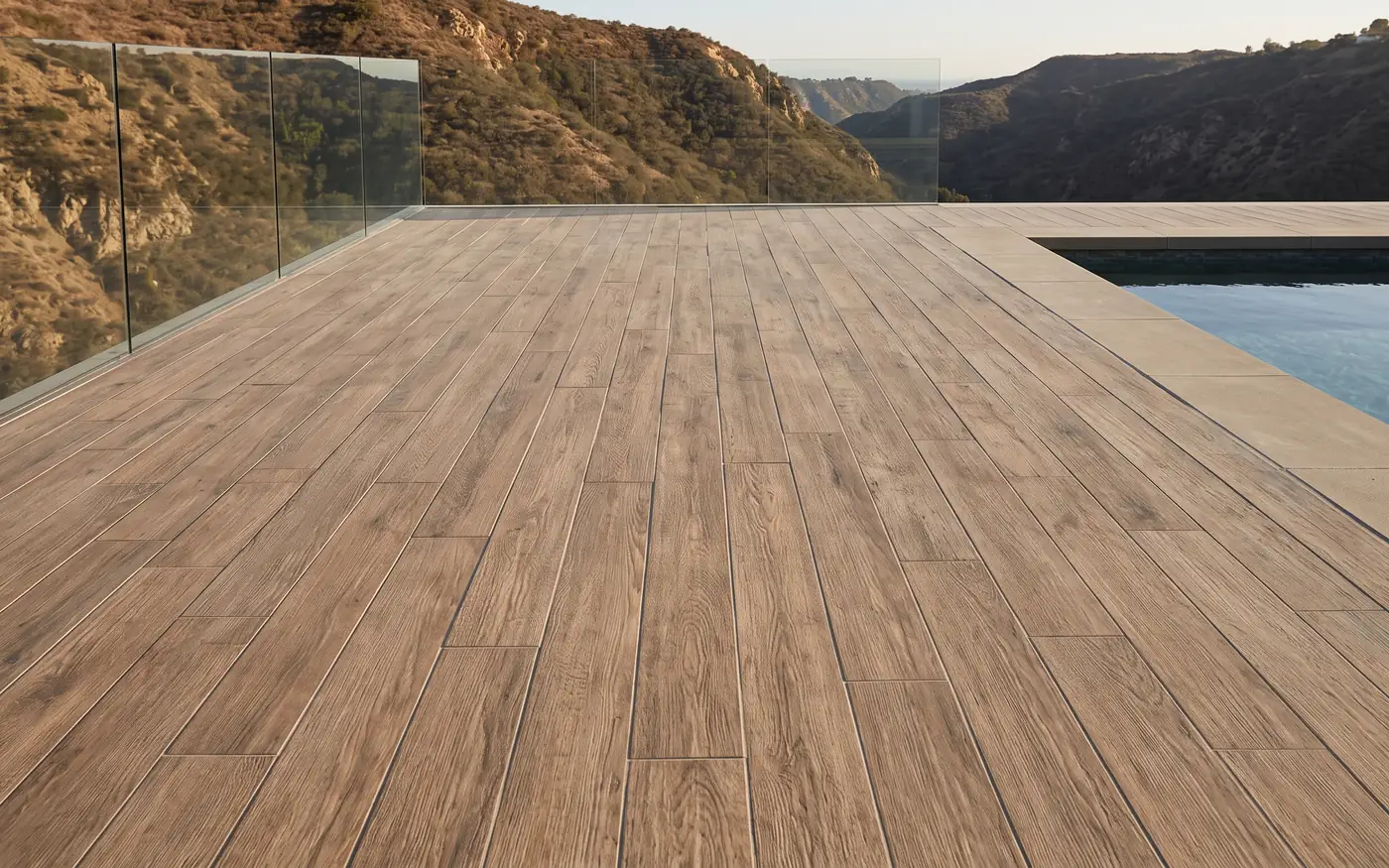
How this plays out on a Calabasas property
Two practical notes, both specific to these lots.
The first is review. Calabasas is its own incorporated city with its own planning and building department, so grading and site work go through the City of Calabasas rather than LADBS, under the grading provisions of Title 15 and the hillside standards in Section 17.20.150. Before any of that, in the gated tracts, the HOA architectural committee decides whether a plank surface fits the community. That is where the material question is actually settled. Committees respond well to a specified product with a manufacturer datasheet and a noncombustible rating, and poorly to a vague description of a look. A submission built around wood-look porcelain, with the exact line named and the layout drawn to scale, gives the committee what it needs the first time.
The second is the ground. Plank formats are long and narrow, which makes them unforgiving of an uneven base. On a cut and fill hillside pad, compaction can differ across a single terrace, and a plank telegraphs that difference far more visibly than a square unit does. Base depth is set to the subgrade actually found on site, laid in compacted lifts, with a geotextile separation where the fill side calls for it. Get that right and the field reads flat for decades. Get it wrong and every plank edge tells you.
Plank surfaces usually sit alongside a conventional paver field rather than replacing it. Details on how those terraces are built are on the paver patios and pool decks page.
Durability is the follow-on question. Service life on Calabasas hillsides handles it.
See the plank before you commit.
The contractor brings samples to the property and renders the terrace in the exact line you choose, with a fixed written quote. The work is done by a licensed contractor. Ask for the workmanship warranty in writing.
Request a 3D renderingNext guide: paver patterns and types or how long pavers last. Back to all guides.